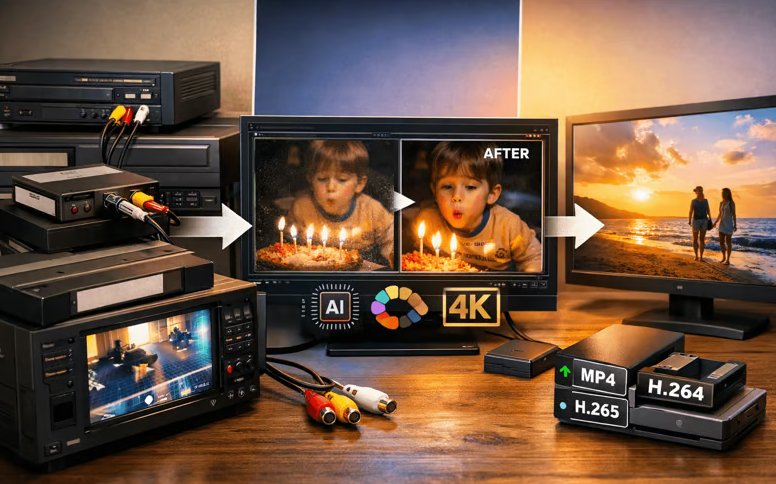
Most people first notice a problem with VHS when they press play, and something feels off. The colors look dull. Faces appear slightly orange or gray. The picture shakes at the top of the frame. What used to feel vivid now feels distant. That moment often raises an uncomfortable question. Is this damage permanent?
VHS tapes record video as an analog magnetic signal. That signal weakens with time, even if the tape sits untouched in a closet. The goal today is not to turn VHS into something it never was.
The real goal is to work with a VHS to digital service that captures what remains accurately, stabilizes playback, and protects the footage from further loss before it becomes unreadable.
What Time Does to a VHS Tape?
VHS was designed for short-term home use, not decades of storage. The tape itself holds tiny magnetic particles that store brightness and color information. As years pass, those particles lose strength. Color information fades first, which explains why old footage often looks washed out long before it looks blurry.
Mechanical wear adds another layer of trouble. Tape stretches slightly with age. That stretching affects timing during playback, which causes horizontal jitter, waviness near the top of the image, or brief vertical shifts. Each pass through a standard VCR increases wear, especially when the tape has already weakened.
Storage conditions matter as well. Heat softens tape binders. Humidity allows mold to form. Dust interferes with the playback heads. Even tapes that look fine on the outside may suffer silent signal loss on the inside.
What “Restoring Color” Really Means for VHS?
Color restoration often sounds more dramatic than it actually is. VHS color cannot be rebuilt once the signal fades. No professional process recreates missing chroma data or modernizes the look of analog footage. What can be done is careful signal capture.
Professional playback equipment reads the tape more consistently than consumer VCRs. That stable read allows existing color information to be captured as accurately as possible. The difference shows up as fewer color jumps, less bleeding, and more consistent tones across scenes.
This approach protects the original character of the footage. It avoids artificial sharpening or recoloring that introduces artifacts and changes how the video originally looked.
Why Stabilization Matters More Than People Expect?
Many playback problems come from timing, not image quality. VHS does not deliver frames at perfectly even intervals. Modern digital systems expect stable timing, so unstable analog signals often confuse them.
This is where Time Base Correction plays a critical role. A Time Base Corrector aligns the video signal during playback so each frame arrives when it should. That process reduces jitter, minimizes frame drops, and keeps audio aligned with video.
Without correction, digitized footage may look fine in short clips but fail during long playback. With correction, the footage becomes consistent and reliable across modern devices.
How Professional VHS Transfers Actually Work?
A proper transfer takes time and patience. It starts with inspection. Each tape is checked for damage, dirt, or mold before playback begins. Cleaning removes debris that could interfere with the heads or scrape the tape surface.
Playback happens in real time on professional decks. There is no scanning or fast capture. The tape plays once from start to finish. During playback, the analog signal passes through Time Base Correction hardware and is converted to digital without altering the original resolution.
After capture, the footage is reviewed. Blank sections are trimmed. Files are named according to tape labels. Sync and playback integrity are checked before delivery.
This process focuses on preservation rather than shortcuts.
See also: Communication Challenges in Technology
Resolution and Why Native Capture Is Best
VHS resolution stays fixed. NTSC tapes capture at 720 by 480 with a 4:3 aspect ratio. PAL tapes capture at 720 by 576, also at 4:3. Capturing at native resolution preserves the full signal without adding distortion.
Upscaling adds pixels, not detail. In many cases, it introduces ringing or edge artifacts that were never present in the original footage. Preservation favors accuracy over visual tricks.
Digital Files or DVDs for Long-Term Access?
Digital files offer flexibility. They store easily, copy quickly, and play on most modern devices. MP4 files work across Windows and macOS systems and remain easy to back up.
DVDs remain useful for people who prefer physical playback. Custom menus and chapters make navigation easier, and dual-layer discs can hold up to four hours of footage. Some collections benefit from having both formats.
When Professional Help Makes Sense?
Home capture setups struggle with unstable tapes. Consumer VCRs lack correction hardware, and capture devices often reject unstable signals. Collections with aging or fragile tapes benefit from a professional VHS to digital service that uses proper playback decks, Time Base Correction, and controlled handling.
That approach reduces risk and improves consistency across large collections.
Final Thoughts
VHS tapes rarely fail all at once. What usually happens is quieter and easier to ignore. Colors soften. The picture wobbles slightly. Audio slips out of sync for a moment, then recovers. Each change feels small, yet together they signal a format reaching the end of its usable life.
Digitization does not turn VHS into something new. It captures what still exists and holds it steady. Stable playback, accurate color capture, and real-time transfer protect footage from further decline. Once that signal is lost, it cannot be recovered later with better tools or newer software.
Many people wait because their tapes still play. That window does not stay open forever. Playback hardware continues to disappear, and aging tape becomes harder to handle safely with each year. Acting sooner preserves more detail, more color consistency, and more of the original experience.
Preserving VHS footage is less about perfection and more about responsibility. These recordings document personal history that exists nowhere else. Capturing them carefully allows those moments to remain accessible, shareable, and intact for years to come.